Replacing One Missing Tooth: Implant or Bridge?
One of the most common questions patients ask after losing a single tooth is surprisingly practical: "Can I fill this gap without touching the healthy teeth next to it?" The honest answer is yes — that is exactly what a single-tooth implant is designed to do. A traditional bridge remains a legitimate option, but the two treatments take very different routes to the same visible result, and the differences matter years down the road.
What Each Option Actually Involves
A three-unit bridge replaces the missing tooth by suspending an artificial tooth between two crowns. To fit those crowns, the two neighboring teeth must be reshaped — a significant amount of healthy enamel is permanently removed, even if those teeth have never had a filling.
A dental implant takes the opposite approach. A small titanium post is placed in the jawbone where the root used to be. After the bone integrates with the post over a few months, a custom crown is attached on top. The adjacent teeth are never drilled, crowned, or loaded — they simply stay as they are. You can read more about how single-tooth dental implant treatment works from planning to final crown.
The Adjacent-Tooth Question
This is where the long-term math diverges. Once a healthy tooth is reduced for a bridge crown, that enamel never comes back. If either supporting tooth later develops decay under its crown or needs a root canal, the entire bridge is usually affected. Long-term reviews of tooth-supported bridges consistently identify the supporting teeth — not the artificial tooth in the middle — as the most common source of complications.
An implant leaves the neighbors independent. Each tooth can be cleaned, examined, and if necessary treated on its own, which keeps future problems contained rather than connected.
What Happens to the Bone Underneath
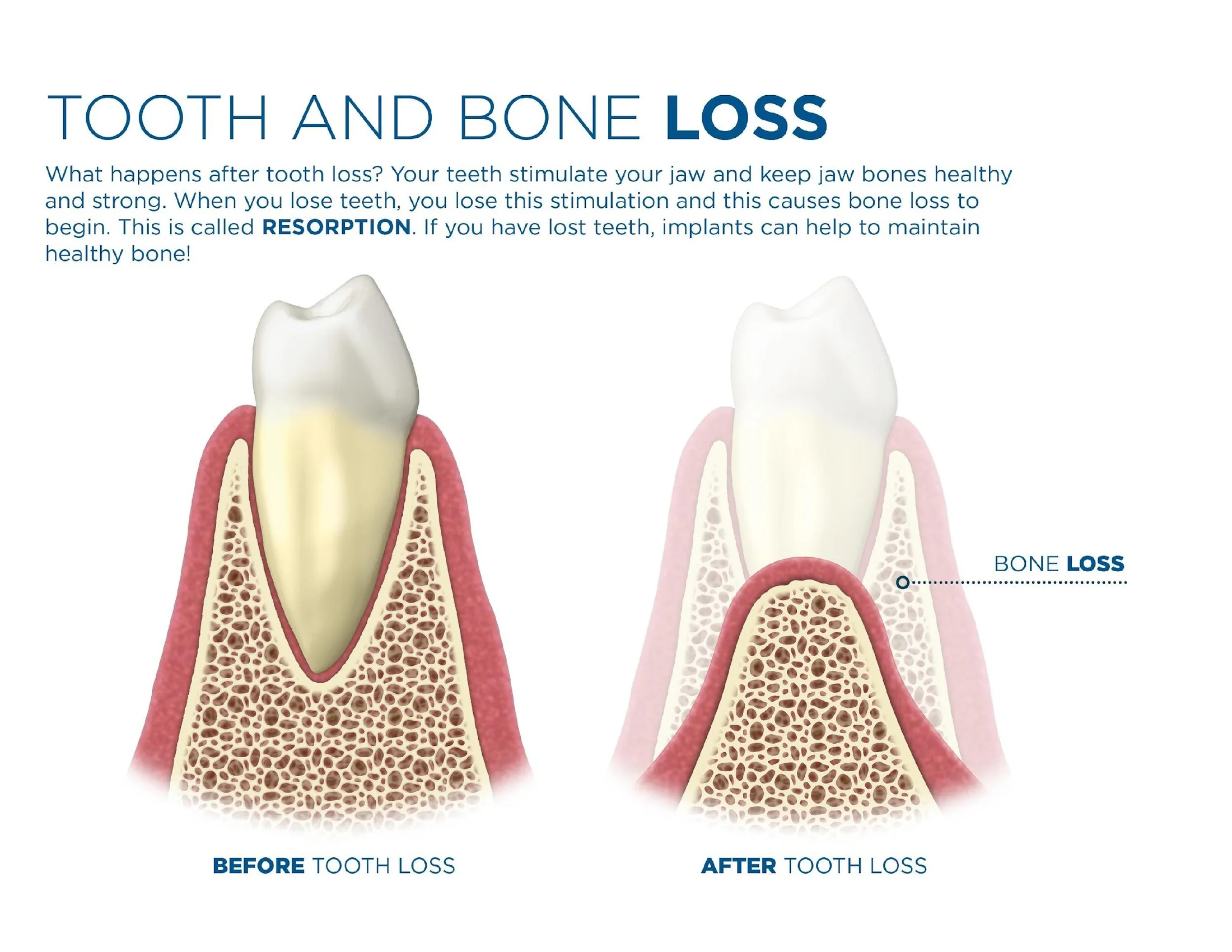
A bridge spans over the gap, but nothing reaches into the bone below it. Without root stimulation, the ridge under the artificial tooth continues to remodel and slowly shrink, which can eventually leave a visible gap under the bridge. An implant transmits chewing forces into the bone the way a natural root does, which helps maintain functional stimulation at the site — though it does not stop all remodeling.
Side-by-Side Comparison
| Factor | Single Implant | Three-Unit Bridge |
|---|---|---|
| Neighboring Teeth | Untouched | Reshaped and crowned |
| Bone at the Gap | Receives chewing stimulation | Continues to remodel unopposed |
| Typical Timeline | 3–6 months including healing | 2–3 weeks |
| Cleaning at Home | Brush and floss like a natural tooth | Requires threading floss under the bridge |
| If One Part Fails | Crown can be replaced independently | Often the whole bridge is redone |
When a Bridge Is Still a Reasonable Choice
- The neighbors already need crowns: If both adjacent teeth are heavily filled or cracked, crowning them serves double duty, and a bridge becomes efficient rather than destructive.
- Surgery is not advisable: Certain medical situations, or bone that cannot be grafted, may make a non-surgical option preferable.
- Time pressure: A bridge can be completed in weeks, while an implant requires a healing period before the final crown.
Making the Decision
The right choice comes down to the condition of the neighboring teeth, the bone available at the site, your health history, and your budget over time — a bridge is usually less expensive up front, while an implant tends to be more economical across decades because it rarely involves retreating other teeth. Reviewing what a single implant typically costs alongside a bridge estimate makes that comparison concrete. Dr. Tafreshi evaluates all of these factors with a 3D scan before recommending either path, because the best option is always the one that matches your mouth, not a general rule.
Considering Dental Implants in Aliso Viejo?
Every smile is unique. Dr. Reza Tafreshi provides comprehensive 3D CT evaluations to assess your bone volume, restoration options (single implants, LOCATOR FIXED™, or All-on-4), and clear pricing before you commit.
- Complimentary 3D imaging & bone density assessment
- Direct coordination with our on-site dental laboratory
- Transparent pricing with zero hidden surcharges

Frequently Asked Questions
Scientific References & Studies
- Pjetursson BE, Brägger U, Lang NP, Zwahlen M. (2007). Comparison of survival and complication rates of tooth-supported fixed dental prostheses (FDPs) and implant-supported FDPs and single crowns (SCs). Clinical Oral Implants Research, 18(Suppl 3):97-113.
- MedlinePlus (U.S. National Library of Medicine). Dental Health — overview of tooth replacement and oral health topics.[Source]